What you are trying to do
You have a ticket. Maybe a feature your customer asked for, maybe a bug your support inbox keeps surfacing, maybe a piece of compliance work you keep pushing to next week. The question that haunts most teams is small and constant: where is that thing right now, and is somebody actually working on it?
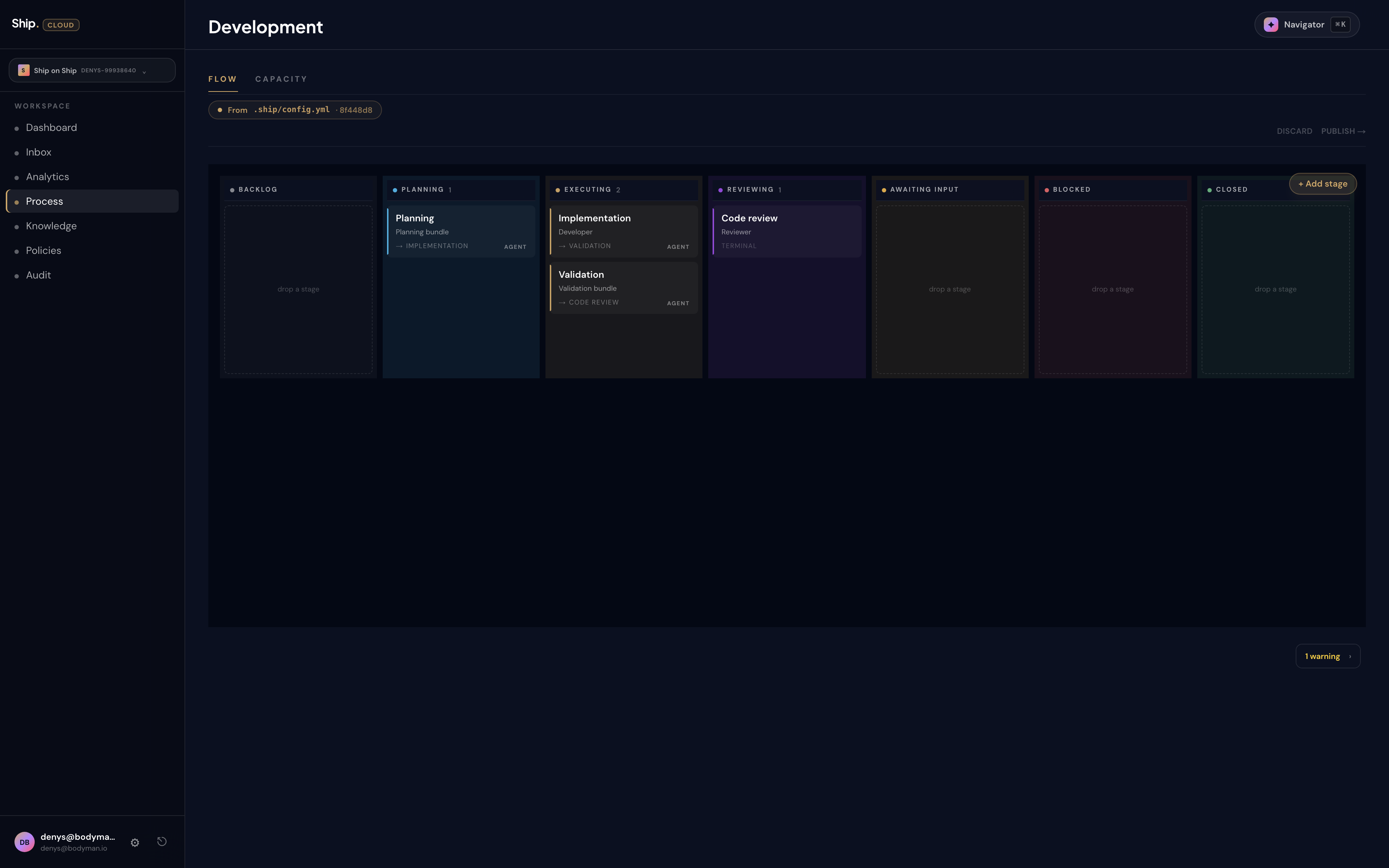
Ship answers that question with seven named states. Every ticket is in exactly one of them. You can stand a new hire in front of the board on day one and they can read it. That is the whole point.
The seven states
Backlog is the wish pile. Work has been written down, but the team has not yet committed to doing it this cycle. Nothing is moving here. Ship will never pick up a ticket from Backlog on its own — promotion to the next state is your decision.
Planning is where a ticket becomes a real plan. A specialist reads the title and description and produces a proper spec, an architecture sketch, and a test plan, in that order. When this state finishes, the ticket has enough shape that an implementer could pick it up without asking you what you meant.
Executing is where the code change happens. A specialist takes the plan from the previous state, writes the change on a fresh branch, and opens a pull request. This is the state with a clock on it — if it sits here for a day with nothing happening, Ship will flag it.
Reviewing is the editorial pass. The pull request is on screen. An agent walks through the change line by line and posts review comments. A human still owns the merge — Ship will never click the green button for you.
Awaiting input is the polite way to say "we are waiting on you." The ticket needs a decision only you can make: a product call, a priority trade-off, a yes or no on scope. Ship stops here on purpose. It will not guess.
Blocked is different from Awaiting input. Awaiting input is "we need your answer." Blocked is "something outside this ticket has to move first" — a flaky test we cannot turn green, an upstream service that is down, a credential nobody can rotate at 11pm. Ship will keep an eye on Blocked items and surface them in your Inbox the moment the obstacle clears.
Closed is what most boards call Done. The pull request landed, the tests are green, and the ticket is settled. Closed is also where work goes when you cancel it on purpose — closed with a reason beats a ticket that just vanishes.
Those seven states connect along a default flow — the path most tickets take: Backlog to Planning to Executing to Reviewing to Closed. Awaiting input and Blocked are detours, not destinations. A healthy week sees most tickets walk the main path and only a few of them pop sideways for a decision.
What this changes about your week
When everyone reads the same seven words the same way, "where are we on the auth refactor?" stops being a meeting. You open the workspace and you see four buckets up top — Needs you, Active, Drafts, Parked — and underneath, every card carries its state. If the answer is "Reviewing," nobody owes you a status update; the pull request is the status.
The other thing this changes is what Monday morning feels like. You no longer have to chase. Anything in Awaiting input is yours. Everything else is either moving on its own or honestly stopped for a reason you can read in one line.